
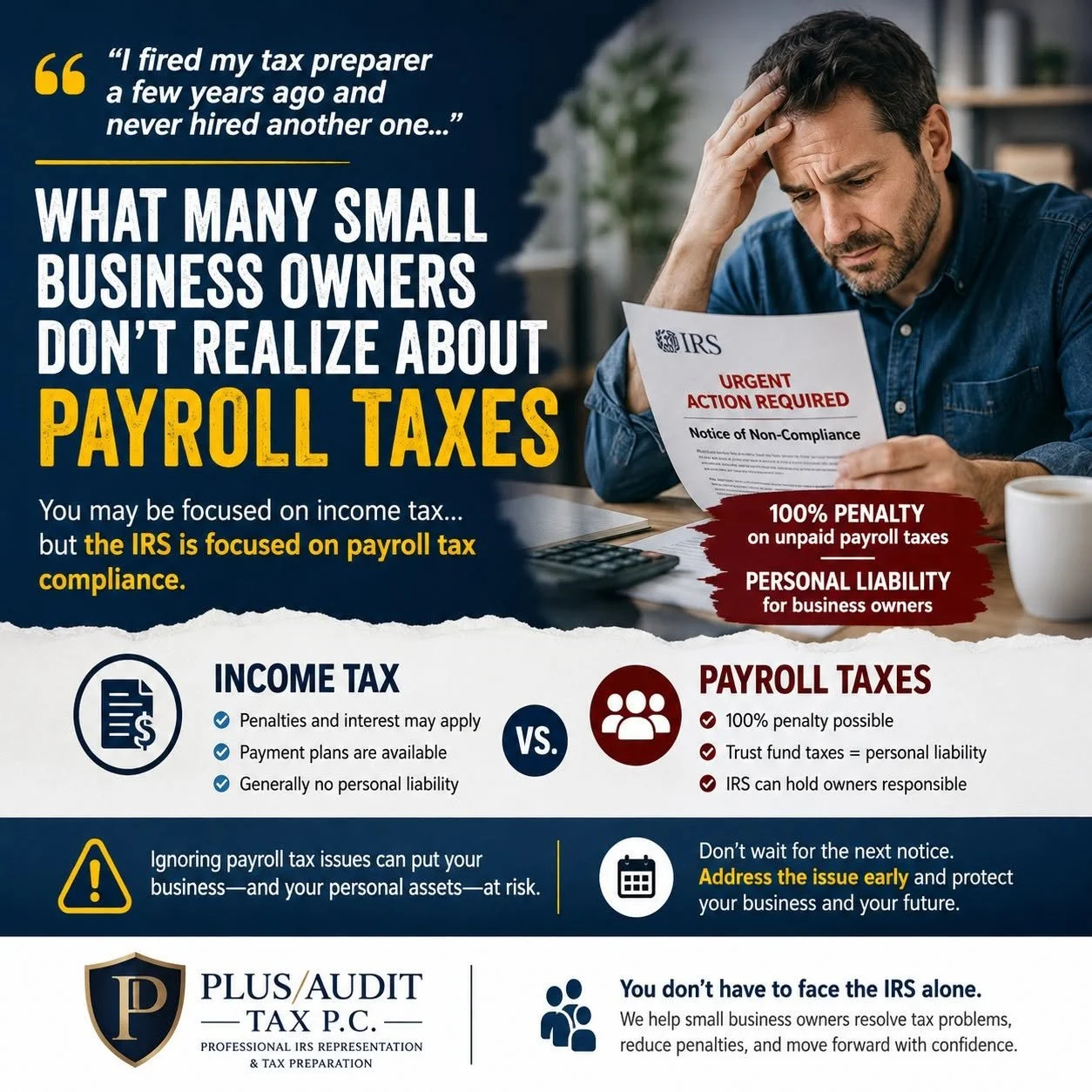
Many business owners assume that all tax problems are treated the same by the IRS. - They’re not.
In fact, payroll tax issues are often among the most serious tax matters a business can face because they don’t always remain business problems. Under certain circumstances, they can become personal liabilities for the individuals responsible for running the company.
To understand why, it helps to know how payroll taxes work. Every time an employer issues a paycheck, a portion of that employee’s wages is withheld for federal income tax, Social Security, and Medicare taxes. Although those amounts temporarily pass through the business, they do not belong to the business. The employer is simply holding those funds in trust until they are remitted to the Internal Revenue Service.
Because of that, the IRS refers to these withholdings as trust fund taxes. This distinction is extremely important.
If a business experiences financial difficulties, owners sometimes face difficult decisions about which bills to pay first. Rent, suppliers, utilities, and payroll itself may all seem urgent. Unfortunately, some businesses postpone making payroll tax deposits, believing they can catch up once cash flow improves.
From the IRS’s perspective, however, those withheld taxes were never the company’s money to spend. They were collected from employees with the expectation that they would be forwarded to the government. That’s why payroll tax non-compliance is treated differently from many other tax issues.
When required payroll tax returns are not filed, payroll tax deposits are missed, or trust fund taxes remain unpaid, the IRS may investigate who was responsible for collecting, accounting for, and paying those taxes. If the IRS determines that a responsible person willfully failed to fulfill those obligations, it may assess the Trust Fund Recovery Penalty (TFRP).
The Trust Fund Recovery Penalty allows the IRS to seek payment of the trust fund portion of the payroll tax liability from responsible individuals—not just from the business itself.
Depending on the facts, a responsible person may include a business owner, corporate officer, partner, payroll manager, bookkeeper, or another individual who had sufficient authority over the company’s financial decisions. Simply holding a title is not enough by itself, and ownership alone does not automatically create liability. The IRS evaluates each case based on the individual’s actual authority, responsibility, and actions. This often surprises business owners.
Many assume that operating through a corporation or LLC completely shields them from payroll tax liabilities. While those business structures provide important legal protections in many situations, they do not necessarily prevent personal liability for unpaid trust fund taxes if the requirements for the Trust Fund Recovery Penalty are met.
Fortunately, not every payroll tax problem results in a Trust Fund Recovery Penalty. Each case depends on its own facts, and the IRS follows a formal investigation before making that determination. Even so, payroll tax issues should rarely be ignored or postponed.
In our experience, many payroll tax problems begin for reasons that have little to do with intentional wrongdoing. A long-time accountant retires, a payroll provider is changed, financial difficulties arise, bookkeeping falls behind, or business owners simply underestimate how quickly missed payroll filings can accumulate.
Whatever the cause, addressing the issue early is almost always easier than waiting for IRS enforcement actions to begin. The sooner missing payroll returns, tax deposits, and reporting issues are identified, the more options are typically available for bringing the business back into compliance and resolving any outstanding liabilities.
Payroll taxes are unlike most other business taxes because they involve money withheld from employees on behalf of the government. Understanding that distinction is one of the most important steps toward avoiding much larger problems in the future.
