
Why IRS Tax Transcripts Matter When Preparing Your Tax Return
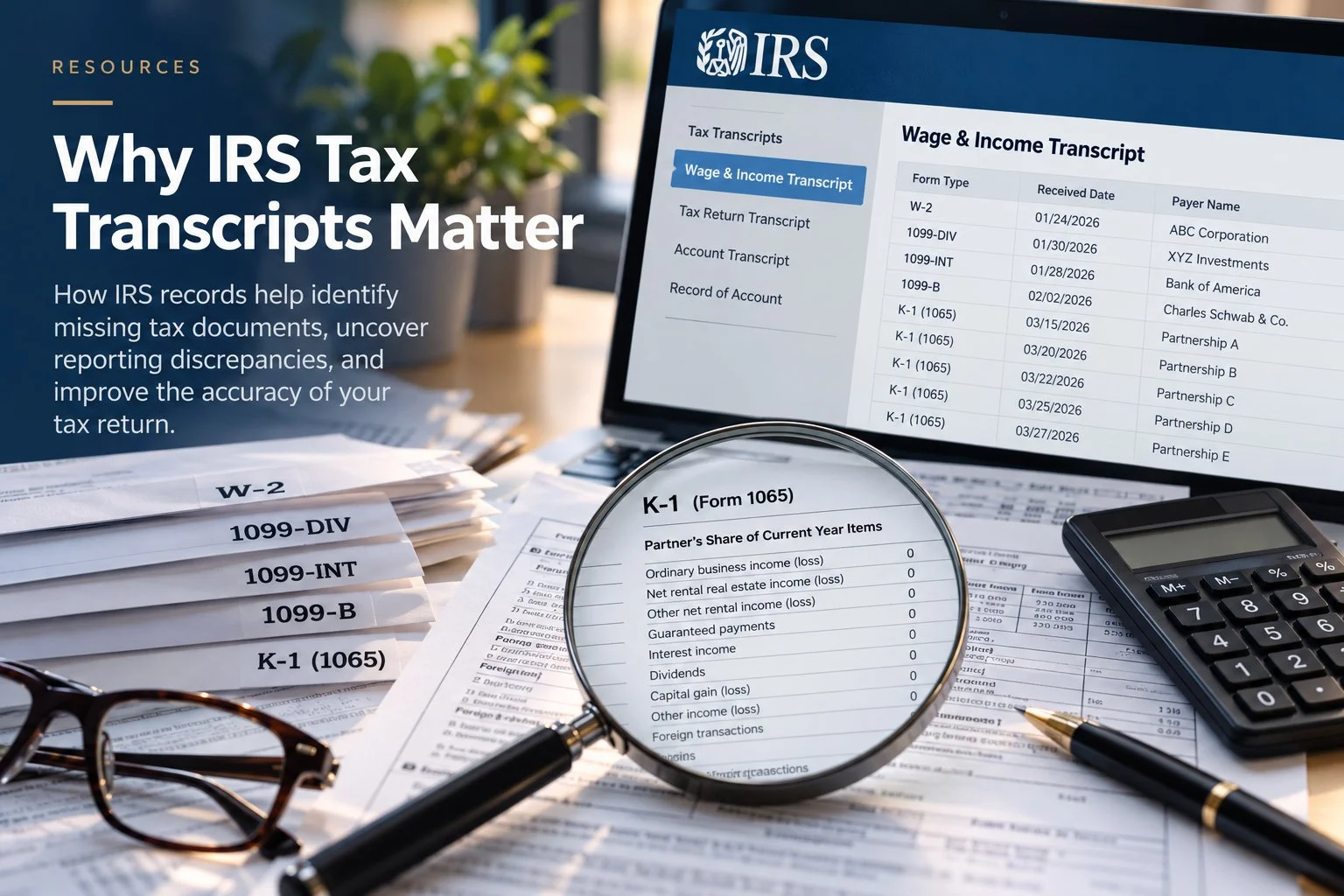
How IRS records help identify missing tax documents, uncover reporting discrepancies, and improve the accuracy of your tax return.
Most taxpayers assume that preparing an accurate tax return is relatively straightforward: collect Forms W-2, 1099, and other tax documents, provide them to a tax professional, and calculate the resulting tax liability. While this approach works in many situations, it relies on one important assumption—that the documents collected by the taxpayer represent a complete and accurate picture of their financial activities.
Unfortunately, that assumption is not always correct. Tax documents can be lost, delivered to an outdated address, overlooked in an online account, or simply never received. Taxpayers with multiple employers, investments, business interests, or activities in several states face an even greater risk of missing important information. In some cases, taxpayers may not even realize that a particular transaction generated a tax reporting obligation.
This is where IRS tax transcripts can become an important part of the tax preparation process. By comparing information provided by the taxpayer with records maintained by the Internal Revenue Service, tax professionals can identify potential omissions, investigate discrepancies, and address certain issues before a return is filed.
What Are IRS Tax Transcripts?
IRS tax transcripts are official records containing information about a taxpayer’s federal tax filings, reported income, payments, and account activity. Different types of transcripts serve different purposes, and understanding these differences is essential when using them during tax preparation.
The Wage and Income Transcript is particularly useful because it contains information reported to the IRS by employers, financial institutions, partnerships, and other third parties. Depending on the taxpayer’s circumstances, these records may include Forms W-2, various Forms 1099, Schedules K-1, and other information returns. In effect, this transcript provides an additional perspective on the taxpayer’s financial activities based on information received by the IRS.
Other transcripts serve different functions. A Tax Return Transcript summarizes information from a previously filed return, while a Tax Account Transcript provides information about processing activity, payments, adjustments, and certain IRS notices or transactions. A Record of Account Transcript combines return and account information where available.
These records are not interchangeable, and none should automatically be treated as a complete substitute for original tax documents. Nevertheless, when used appropriately, they can provide valuable information that might otherwise be overlooked.
Identifying Missing Tax Documents Before Filing
One of the most practical applications of IRS transcripts is identifying tax documents that a taxpayer has not provided. Consider an individual who worked for several employers during the year, maintained multiple investment accounts, and received distributions from retirement plans. The taxpayer may believe that all necessary documents have been collected, even though a former employer sent a W-2 to an outdated address or a financial institution made a Form 1099 available exclusively through an online portal.
Without additional verification, the tax return might be prepared using incomplete information. The missing income could subsequently be identified through the IRS’s automated information-matching procedures, potentially resulting in correspondence, additional tax assessments, interest, or penalties.
A Wage and Income Transcript can help identify these discrepancies before filing. When a transcript contains an information return that does not appear among the taxpayer’s documents, the tax professional has an opportunity to investigate its source, request the original document, and determine whether the reported information should be included in the return.
Importantly, the presence of an information return in an IRS transcript does not automatically establish that the reported amount is correct or taxable. Third-party reporting errors occur, and some transactions require additional analysis to determine their proper tax treatment. The transcript identifies a potential issue; professional judgment and supporting documentation are still necessary to resolve it.
A Practical Example: Missing Partnership Schedules K-1
Partnership interests illustrate why transcript verification can be especially valuable in more complex tax situations. Imagine a taxpayer who previously participated in several business partnerships and provides only two Schedules K-1 for the current tax year. The taxpayer believes these are the only partnership documents required for the return. However, a review of the taxpayer’s IRS Wage and Income Transcript identifies information associated with more than ten partnership Schedules K-1. Further examination reveals that most of the additional K-1 records contain no current-year income and show zero percentages for certain partnership ownership interests.
At first glance, the absence of taxable income might suggest that the additional K-1 records are irrelevant. However, the situation raises several important questions. When were the partnership interests acquired? Were they terminated before or during the tax year? Did the taxpayer receive any payments or other consideration upon termination? Were the partnerships required to issue final Schedules K-1? Could there be suspended losses, basis adjustments, or other tax consequences associated with the terminated interests?
These questions matter because a partnership interest can have tax consequences even when its Schedule K-1 reports no ordinary business income. Depending on the circumstances, a disposition may generate a capital gain or loss, ordinary income attributable to certain partnership assets, or other adjustments that require consideration on the taxpayer’s individual return.
The IRS generally requires partnerships filing Form 1065 to furnish Schedule K-1 to each person who was a partner at any time during the partnership’s taxable year. Accordingly, the termination of a partnership interest does not necessarily eliminate the partnership’s reporting responsibilities for the year in which the termination occurred. The original Schedules K-1, accompanying statements, partnership agreements, and termination documents may therefore be necessary to understand the complete tax consequences.
This example demonstrates an important principle: a tax document reporting zero income is not necessarily a document with zero tax significance. Without reviewing the IRS transcripts, the existence of these additional partnership records—and the questions they raise—might never have come to the preparer’s attention.
Reducing the Risk of IRS Notices and Subsequent Corrections
The IRS receives substantial amounts of information directly from employers, financial institutions, and other reporting entities. Its automated systems compare certain information returns against amounts reported on taxpayers’ individual income tax returns. When discrepancies are identified, the IRS may issue a notice requesting clarification or proposing changes. One familiar example is Notice CP2000, which is generally issued when information reported by third parties does not match the income or payment information shown on a taxpayer’s return.
Receiving a CP2000 does not necessarily mean that the taxpayer made an error or owes additional tax. The third-party information itself may be incorrect, or the discrepancy may have a legitimate explanation. Nevertheless, responding to the notice can require additional documentation, correspondence, and professional assistance. Reviewing available IRS transcripts during tax preparation can help identify some of these discrepancies before they result in correspondence. This is particularly useful when the taxpayer has numerous income sources, investment transactions, or business interests.
However, transcript verification cannot guarantee that a taxpayer will avoid IRS notices. Some information may not yet have been processed, certain reporting discrepancies may not be visible in the available records, and other tax issues may arise independently of third-party information reporting. The objective is not to eliminate every possible risk but to introduce an additional level of verification where it is appropriate.
IRS Transcripts Can Reveal Issues Beyond the Current Tax Year
Another important benefit of reviewing transcripts is the opportunity to identify matters that may require examination of previous tax years. For example, a current-year Schedule K-1 may indicate the existence of a partnership interest that does not appear in the taxpayer’s prior-year tax preparation records. This does not automatically mean that the earlier return was incorrect. A partnership may have generated no reportable income, deductions, or credits, or the taxpayer’s interest may not have produced an entry directly visible on Form 1040.
Nevertheless, the discrepancy may justify further investigation. The taxpayer could have unused passive activity losses, partnership basis adjustments, or other tax attributes that affect the treatment of current-year transactions. Similarly, IRS account transcripts may reveal estimated tax payments, adjustments, or filing activity that should be reconciled with the taxpayer’s records. For taxpayers whose financial circumstances have become more complex over time, reviewing historical information can help establish continuity between tax years and reduce the likelihood that relevant tax attributes are overlooked.
Important Limitations of IRS Tax Transcripts
Although IRS transcripts are valuable, they should not be viewed as a complete or infallible source of tax information.
First, transcript information may be incomplete or unavailable when a return is being prepared. Information returns must be submitted and processed before they can appear in IRS records. Consequently, a transcript obtained early in the filing season may not include all documents relevant to the tax year. Amended or corrected information returns may also take additional time to appear.
Second, IRS transcripts primarily reflect federal information reporting. They may not contain the state-specific details necessary to prepare accurate state income tax returns. For example, a federal Wage and Income Transcript may not provide all the state wage, withholding, or allocation information shown on an original Form W-2. This limitation becomes particularly important for taxpayers who worked or earned income in multiple states.
Third, transcripts may omit supporting information needed to determine the correct tax treatment of a transaction. A partnership Schedule K-1 may include supplemental statements explaining separately stated items, deductions, credits, or other tax attributes. Similarly, investment transactions may require cost-basis information or adjustments that cannot be fully established from transcript records alone.
Fourth, third-party information is not always correct. An information return may have been issued in error, assigned to the wrong taxpayer, or prepared using inaccurate amounts. Tax professionals should investigate discrepancies rather than automatically accept every reported figure as accurate.
Finally, IRS transcripts cannot identify every potentially taxable transaction. Income or other tax events that were never reported to the IRS by a third party may still need to be included in a taxpayer’s return. For these reasons, transcripts should be used as a supplementary verification tool rather than a replacement for taxpayer records, original documents, and appropriate professional analysis.
Does Every Tax Return Require an IRS Transcript Review?
Not necessarily. The need for transcript verification depends on the taxpayer’s circumstances, the completeness of available documentation, and the complexity of the return. For an individual with a single employer, straightforward income sources, and complete tax records, reviewing IRS transcripts may provide relatively little additional benefit.
The situation can be different for taxpayers with multiple employers, investment accounts, partnership interests, retirement distributions, prior-year filing issues, or missing tax documents. In these cases, obtaining and reviewing available transcripts may be a valuable step in establishing whether the information used to prepare the return is sufficiently complete. Tax professionals are not generally required to obtain IRS transcripts for every return they prepare. They are, however, subject to applicable professional standards and due diligence responsibilities. When information appears incomplete, inconsistent, or incorrect, further reasonable inquiries may be appropriate. The decision to use transcripts should therefore be based on the specific circumstances rather than treated as a universal requirement.
A More Complete Approach to Tax Preparation
Accurate tax preparation involves more than transferring numbers from tax documents into software. It requires understanding the taxpayer’s financial circumstances, evaluating the information provided, identifying inconsistencies, and determining the proper tax treatment of relevant transactions. IRS tax transcripts can contribute to this process by providing an additional source of information against which taxpayer records can be compared. They may reveal documents that were never received, identify discrepancies that warrant investigation, or highlight prior-year issues that affect the current return.
