
Does Owing the IRS Mean You Need an Offer in Compromise?
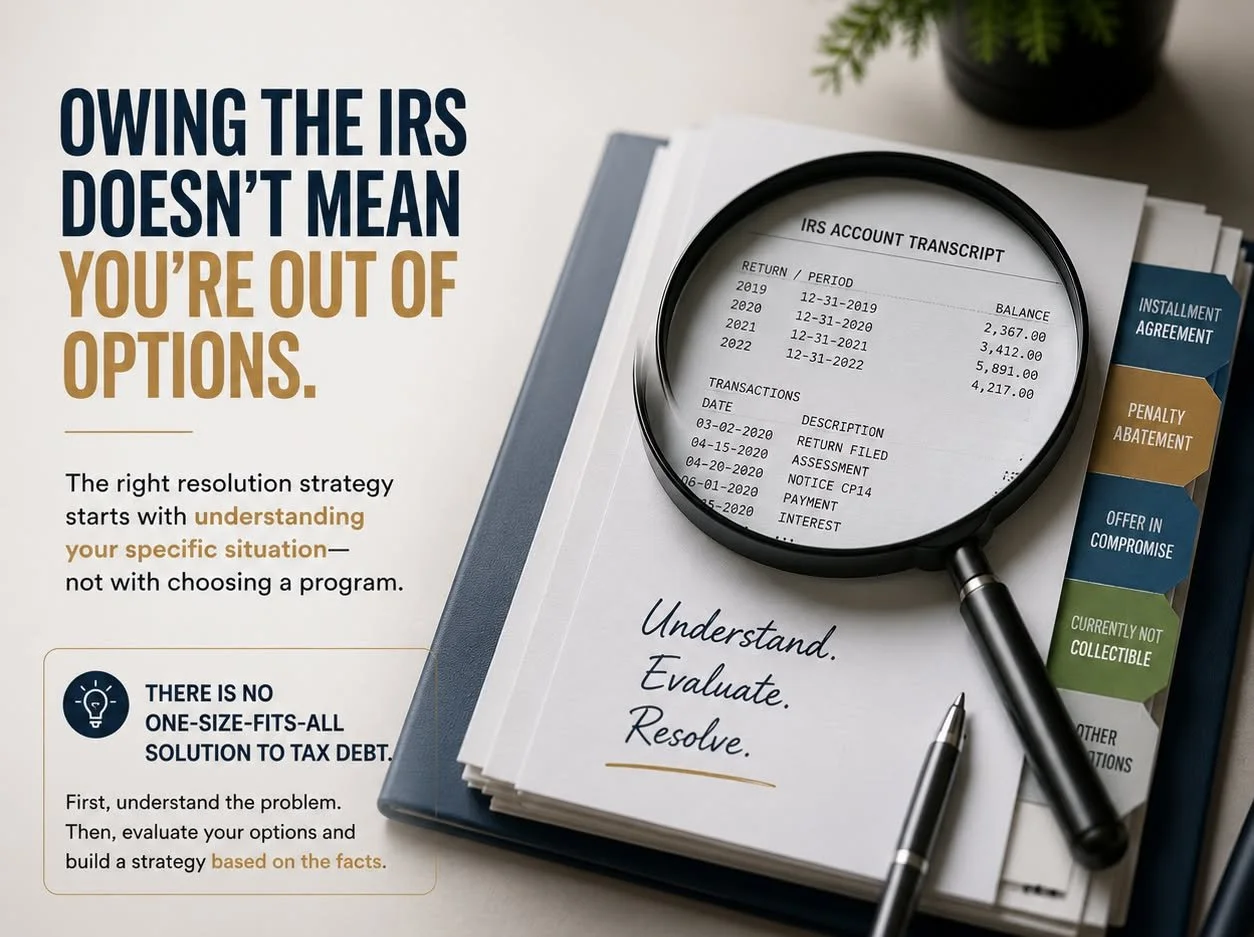
When taxpayers receive a large IRS balance due, many immediately begin searching online for one solution: an Offer in Compromise.
The program has received considerable attention over the years, and it is often advertised as a way to “settle your tax debt for less than you owe.” While an Offer in Compromise can be an effective resolution option for some taxpayers, it is not the appropriate solution in every case.
In fact, many taxpayers resolve their tax liabilities through other collection alternatives that may be better suited to their financial circumstances.
The Internal Revenue Service offers several options for taxpayers who are unable to pay their tax liabilities in full. Depending on the facts of the case, those options may include an Installment agreement, penalty relief, Currently Not Collectible (CNC) status, an Offer in Compromise, or other collection strategies available under the Internal Revenue Code and IRS administrative procedures.
The appropriate resolution cannot be determined by looking at the amount of tax owed alone.
Instead, the IRS considers a variety of factors, including the taxpayer’s current income, available assets, allowable living expenses, future ability to pay, filing compliance, and the remaining statutory period for collecting the liability. The circumstances that caused the tax debt may also influence the overall strategy, particularly when penalty relief or compliance issues are involved.
Because each collection alternative has its own eligibility requirements and long-term consequences, selecting a resolution strategy should be based on a thorough understanding of the taxpayer’s financial and tax situation rather than on a preference for a particular IRS program.
For example, an Offer in Compromise may be appropriate when a taxpayer’s reasonable collection potential is significantly less than the total amount owed. In other situations, an affordable installment agreement may resolve the liability without requiring the taxpayer to liquidate assets or seek a compromise. Taxpayers experiencing significant financial hardship may qualify for Currently Not Collectible status, while others may benefit from requesting penalty relief if they meet the applicable requirements.
No single option is inherently better than another. Each serves a different purpose, and the most effective approach depends on the facts of the individual case.
For that reason, tax resolution should generally begin with an investigation rather than with a decision about which IRS program to pursue. Understanding the taxpayer’s financial condition, reviewing IRS account transcripts, confirming filing compliance, and evaluating the available collection alternatives provide the foundation for selecting an appropriate strategy.
Choosing the correct resolution often has less to do with finding the most popular IRS program and more to do with identifying the option that best fits the taxpayer’s specific circumstances. A well-developed strategy is rarely built around a single solution—it is built around the facts.
